Truck Undercoating in Naperville: Protecting Against Road Salt
Google Reviews
What our Customers say
Heading 1
Heading 2
Heading 3
Heading 4
Heading 5
Heading 6
Lorem ipsum dolor sit amet, consectetur adipiscing elit, sed do eiusmod tempor incididunt ut labore et dolore magna aliqua. Ut enim ad minim veniam, quis nostrud exercitation ullamco laboris nisi ut aliquip ex ea commodo consequat. Duis aute irure dolor in reprehenderit in voluptate velit esse cillum dolore eu fugiat nulla pariatur.
Truck undercoating in Naperville can help protect exposed underbody metal from the road salt, moisture, slush, gravel, and grime that Illinois trucks encounter every winter. Pickup trucks often spend years driving through treated roads, wet parking lots, job sites, snow, and standing water, which makes the underside worth paying attention to long before rust becomes easy to see.
Illinois road crews rely heavily on salt during winter weather. The Illinois Department of Transportation says rock salt is its main deicing material, with salt brine and other liquid treatments also used during winter operations. IDOT reported spreading more than 357,500 tons of salt statewide through April 2026.
That material helps make winter roads safer, but salty road spray can reach frame rails, wheel wells, suspension areas, floor pans, crossmembers, and other exposed sections beneath a truck.
Z Tech Window Tinting offers undercoating and rustproofing for trucks, cars, and SUVs from our Naperville, IL and Countryside, IL locations.
If you own a pickup and plan to keep it through several Illinois winters, here is what you should know about protecting the underside.
Illinois winters create a rough environment underneath a pickup.
Snow is only part of it.
A truck can encounter:
Rock salt
Salt brine
Meltwater
Slush
Mud
Gravel
Sand
Ice
Standing water
Road debris
IDOT says rock salt lowers the freezing point of water and is widely used to melt or prevent snow and ice on Illinois roads. The agency also uses liquid treatments to help salt stick to pavement and to treat bridges before frost or winter storms.
Once traffic starts moving across treated pavement, salty moisture can be thrown underneath vehicles by the tires.
A truck’s ride height does not prevent this exposure.
In some cases, trucks are driven in conditions that passenger cars rarely see, including construction sites, gravel roads, farm property, boat ramps, muddy lots, and deep snow.
Truck Undercoating In Naperville: Protecting Against Road Salt Naperville, Il & Countryside, Il | Bz8Owhu9Pj9Fu04Gf7Epa Dzg0Wrfa
That makes truck undercoating in Naperville worth considering for both work trucks and personal pickups.
What Truck Undercoating Does
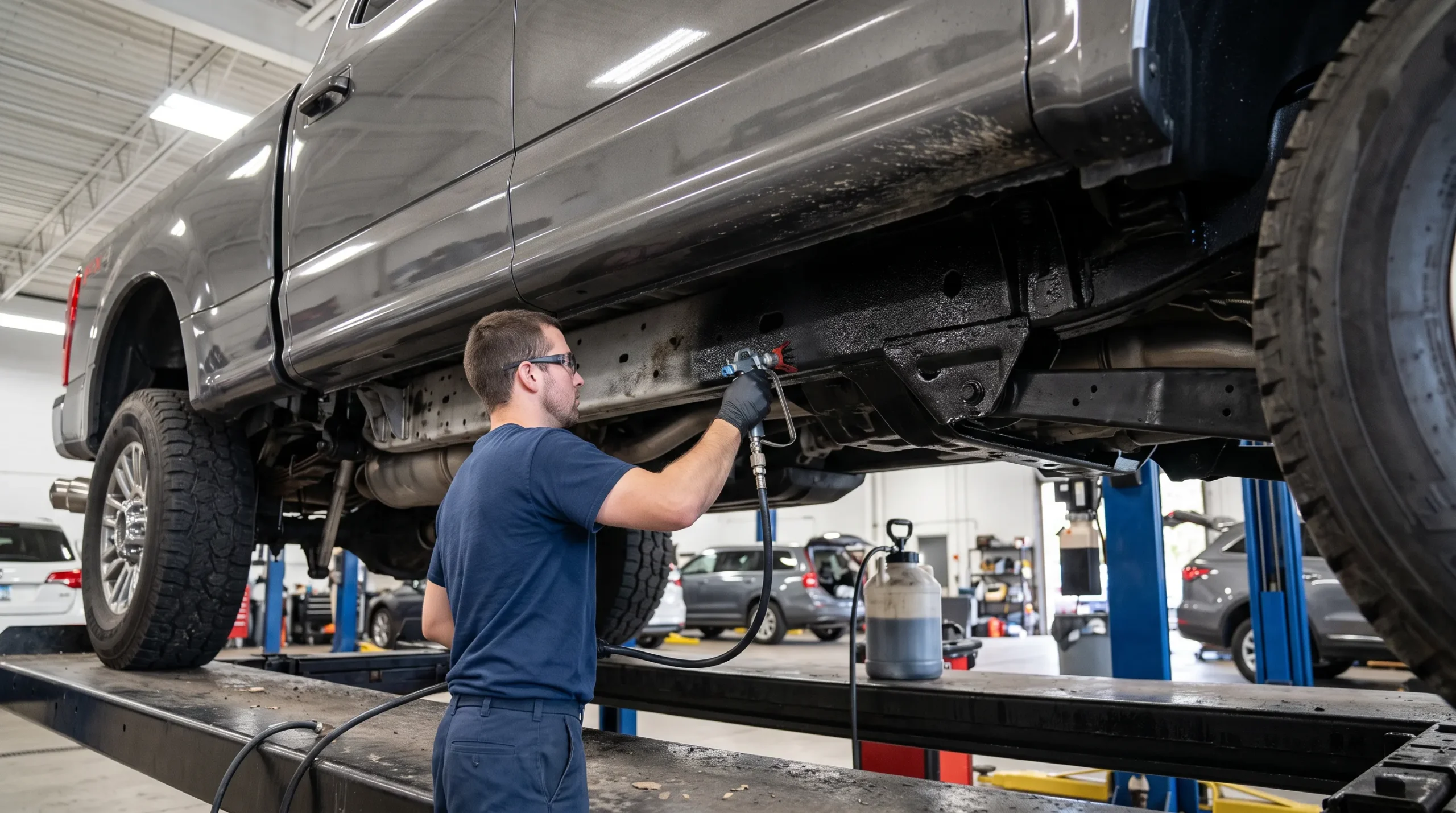
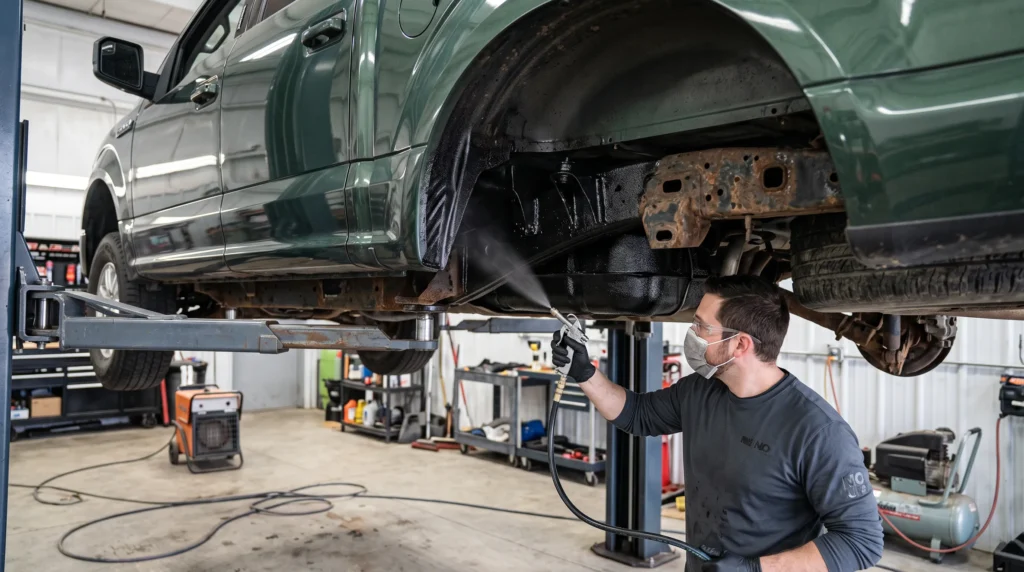
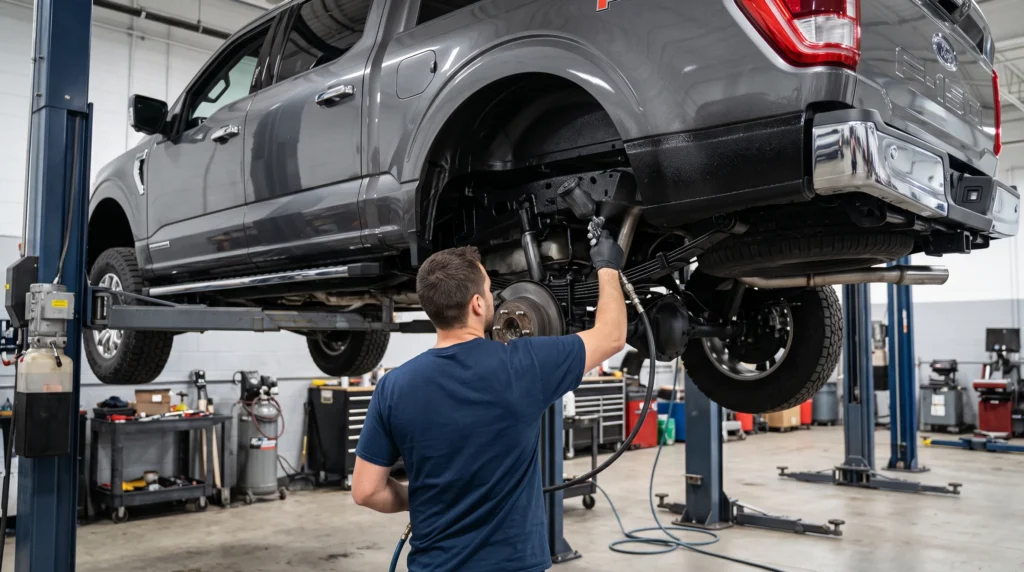
Undercoating places a protective layer over suitable sections of the underside.
Its job is to create separation between exposed surfaces and things coming off the road.
Depending on the coating used, undercoating can help protect against:
Moisture
Road salt
Salt spray
Gravel
Chipping
Road grime
Abrasion
Weather exposure
Some coatings dry into a thicker textured layer.
Others remain soft.
Some are better suited to exposed underbody sections, while others are used inside seams, cavities, and hidden areas.
That is why asking what product and process a shop uses can tell you more than simply asking whether undercoating is available.
Truck Areas That Take the Most Winter Abuse
Not every part of a truck sees the same exposure.
The tires throw water, salt, stones, and dirt toward nearby components as the truck moves.
Areas worth inspecting include:
Frame rails
Crossmembers
Wheel wells
Inner fenders
Floor pans
Rocker areas
Suspension mounting areas
Bed supports
Cab mounts
Areas behind the front wheels
Areas ahead of the rear wheels
Seams and overlapping metal
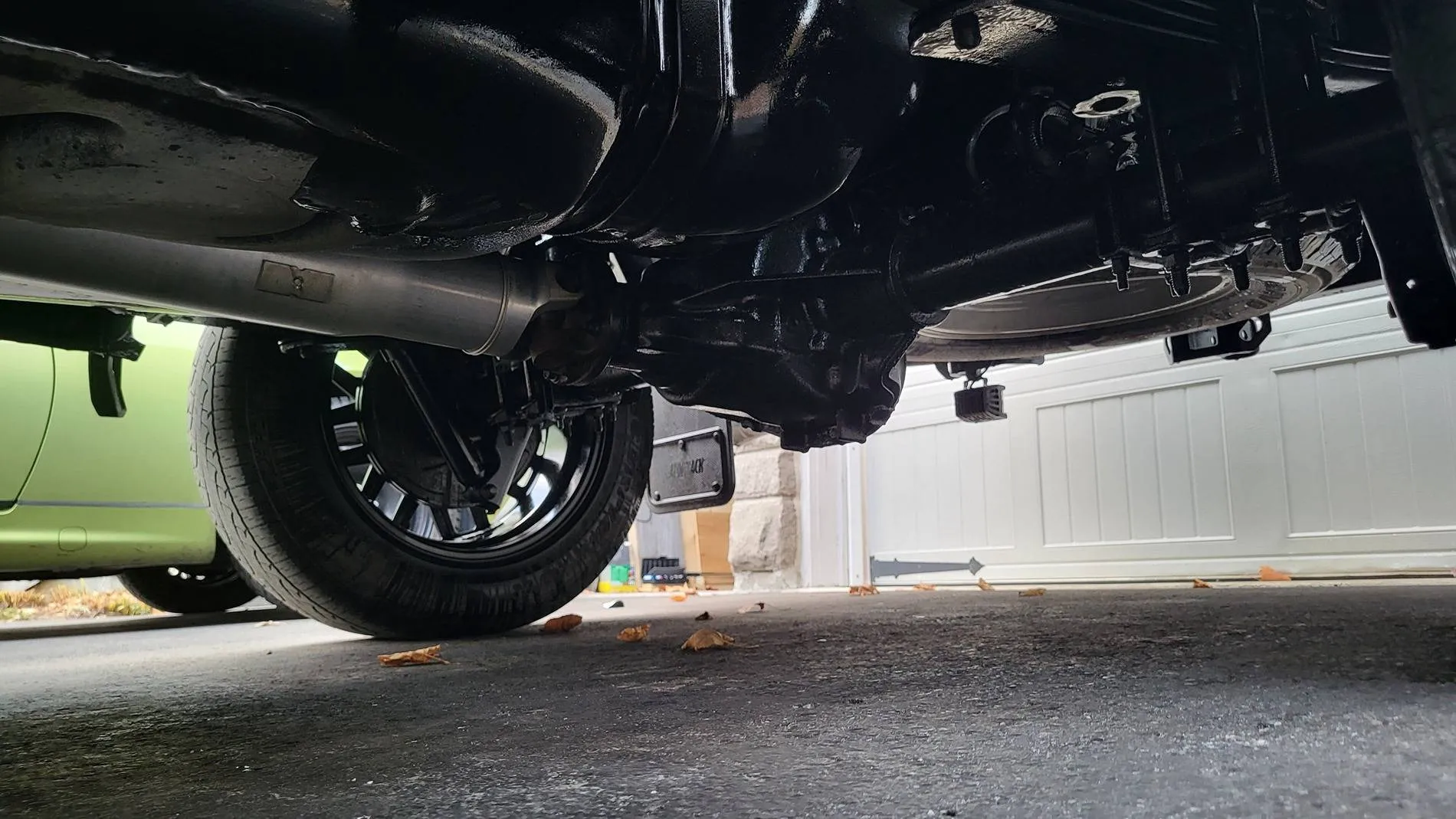
Pickup trucks can also have large sections of frame and underbody metal exposed to road spray.
If you use your truck for towing, hauling, snow removal, construction, landscaping, or other year-round work, those areas may see repeated winter exposure.
Why Pickup Frames Need Attention
Body-on-frame trucks have a separate structural frame running beneath the cab and bed.
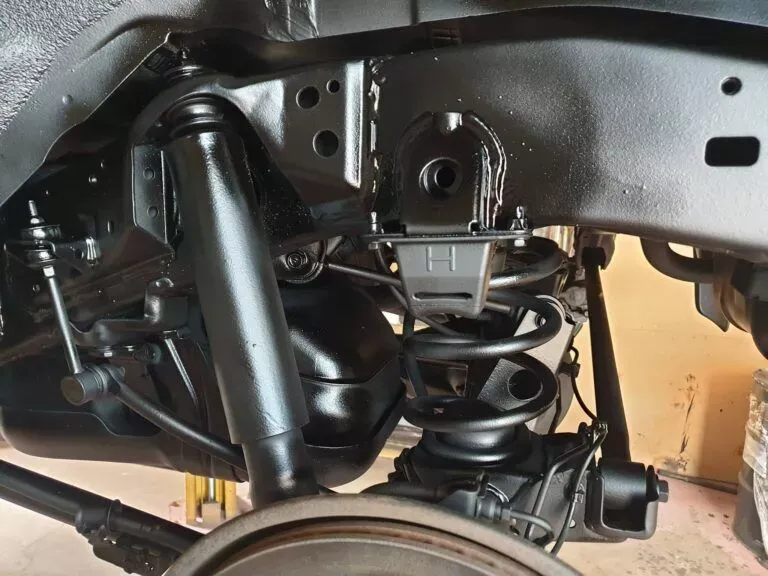
That frame contains rails, crossmembers, brackets, welds, seams, holes, and mounting points.
Those shapes create many areas where road spray can reach the metal.
Some sections may also hold dirt and moisture after a winter drive.
The underside can look fine from normal standing height while corrosion begins in places you rarely inspect.
That is why truck undercoating in Naperville is often discussed as preventive care rather than something to consider only after heavy rust appears.
Undercoating cannot reverse structural damage.
Starting while the truck is in good condition gives the coating a better surface to protect.
Undercoating vs Rustproofing
Undercoating and rustproofing are closely related, but they are not always the same service.
Undercoating
Undercoating usually focuses on exposed sections beneath the vehicle.
Those may include:
Frame sections
Wheel wells
Floor pans
Underbody panels
Inner fenders
Other exposed metal
A thicker coating can also help protect suitable surfaces from gravel and abrasion.
Rustproofing
Rustproofing may include hidden areas where a thick underbody coating cannot easily reach.
Rubberized undercoating creates a thicker protective coating over suitable underbody areas.
Products in this category are made to resist moisture, road spray, abrasion, and chipping.
3M states that its professional rubberized undercoating is suitable for trucks and can be applied to areas such as wheel wells, fenders, floor pans, and undercarriages.
3M also describes rubberized undercoating products that resist salt spray, weathering, chipping, and dust.
Why Truck Owners Consider Rubberized Coatings
A rubberized coating can make sense on suitable exposed areas because trucks regularly encounter:
Gravel
Salt spray
Road debris
Mud
Water
Snow
Tire spray
The material forms a thicker barrier than a thin oil film.
Some rubberized coatings also have sound-dampening properties.
That can help reduce some road noise coming through treated panels.
It does not turn a pickup into a silent vehicle, but noise reduction can be a side benefit of certain coatings.
Oil and Wax Rust Protection
Oil and wax products take another approach.
Rather than forming the same thick textured layer associated with rubberized undercoating, these coatings can remain thinner and work their way into seams and cavities.
Oil-Based Protection
Oil-based rust treatments usually remain soft.
That allows the material to move into:
Seams
Gaps
Joints
Frame openings
Overlapping metal
A soft coating may require repeat treatment because road spray and washing can wear it away.
Wax-Based Protection
Wax-based products are often used to create a water-resistant film inside cavities and seams.
A wax product may begin as a liquid and leave a protective film after its carrier evaporates.
These coatings can be useful where a thick rubberized layer would not make sense.
The right treatment depends on the truck, the area being protected, and its current condition.
Why Surface Preparation Matters
A protective coating is only as good as the surface underneath it.
Spraying over salt, dirt, mud, loose rust, grease, or trapped moisture does not solve the underlying problem.
3M’s corrosion-protection procedures place cleaning and surface preparation before undercoating application.
A truck should be inspected before coating begins.
Preparation may include:
Cleaning the underside
Removing road grime
Drying the surface
Removing loose material
Checking for corrosion
Checking previous coatings
Masking parts that should not receive product
Some parts of a truck should not simply be sprayed with undercoating.
These can include exhaust components, brake parts, drain areas, moving components, sensors, and other service points.
Correct application requires knowing where the coating belongs and where it does not.
Can You Undercoat a Truck With Existing Rust?
Sometimes.
It depends on how much rust is present and where it is located.
Light surface corrosion and severe structural rust are very different problems.
Undercoating does not rebuild damaged steel.
It also does not repair:
Rust holes
Weak frame sections
Failed mounting points
Severely corroded brake-line areas
Damaged suspension mounts
If rust is already present, the underside should be inspected before coating.
Loose material may need attention before a protective layer is applied.
The catch is simple: hiding severe corrosion under a black coating does not make the metal sound again.
If you recently bought a used pickup, an inspection can help you understand the starting condition before deciding on truck undercoating in Naperville.
Should a New Truck Be Undercoated?
A newer truck can be a good candidate because the underside may have little corrosion when treatment begins.
That allows the coating to protect metal before years of winter exposure build up.
This can be worth considering if you:
Plan to keep the truck for years
Drive throughout winter
Park outside
Tow during winter
Use the truck for work
Travel on salted highways
Drive gravel or rural roads
Live in Naperville, IL or nearby suburbs
Factory corrosion protection already exists on modern vehicles.
Aftermarket undercoating does not mean the factory did nothing.
The question is whether you want another protective layer on suitable areas because of the conditions your truck will face.
Does Undercoating Help With Gravel and Road Debris?
Certain undercoating products are designed to resist more than moisture.
Rubberized coatings can help protect suitable areas from abrasion and chipping caused by gravel and road debris.
3M describes its rubberized undercoating as resisting chipping, abrasion, exterior rusting, and weather exposure.
This can be useful around wheel wells and other high-spray zones.
Imagine what happens behind a tire during winter.
The tire can throw a mixture of:
Saltwater
Slush
Sand
Small stones
Dirt
That repeated contact can be hard on exposed surfaces.
A suitable coating creates another layer between those materials and the metal underneath.
Do You Still Need to Wash an Undercoated Truck?
Yes.
Undercoating does not cover every part beneath a truck.
Salt can still collect around:
Suspension components
Shields
Fasteners
Brackets
Wheels
Brake components
Uncoated surfaces
Areas around the coating
Washing helps remove salt and dirt from places that remain exposed.
Paying attention to the underside after winter storms is still worthwhile.
A protective coating should be treated as part of a broader winter-care routine rather than permission to leave salt on the truck until spring.
Inspect the Coating After Winter
Undercoating should not be forgotten once it is applied.
Truck use can be hard on coatings.
Gravel, road debris, jack placement, repairs, off-road driving, and service work can damage treated areas.
Inspect the underside periodically for:
Chips
Worn coating
Exposed metal
Peeling areas
New rust
Damage near wheel wells
Areas affected by repairs
If a suspension part, frame section, or body panel is repaired, the protective coating in that area may also need attention.
Checking the underside after winter gives you a chance to find worn areas before another season begins.
Truck Undercoating for Work Pickups
Work trucks often face harsher conditions than personal vehicles.
A contractor’s pickup may spend the morning on salted pavement and the afternoon in a muddy job site.
Landscaping trucks can encounter dirt, fertilizer, water, and gravel.
Snow-plow trucks operate during the exact conditions when road salt and brine are being spread.
Construction pickups may travel across unfinished surfaces and wet lots.
For these trucks, underbody protection can be worth discussing early in ownership.
Z Tech serves pickup owners throughout Naperville, IL and Chicago’s west suburbs.
Truck Undercoating in Naperville, IL
Drivers looking for truck undercoating in Naperville can visit:
Z Tech Window Tinting 1572 W Ogden Ave Naperville, IL 60540 Phone: (630) 355-9555 Hours: Monday through Saturday, 8:30 AM to 5:00 PM
Z Tech is a family-owned automotive care and protection business serving Chicago’s west suburbs since 1975.
Our Naperville location has more than 375 five-star reviews.
We also have a Countryside, IL location:
Z Tech Window Tinting 9825 W 55th St #D Countryside, IL 60525 Phone: (708) 354-9555 Hours: Monday through Saturday, 8:30 AM to 5:00 PM
Our Countryside location has more than 365 five-star reviews.
Truck owners visit us from communities near Naperville, IL, including:
Aurora, IL
Lisle, IL
Warrenville, IL
Plainfield, IL
Bolingbrook, IL
Woodridge, IL
Downers Grove, IL
Darien, IL
Westmont, IL
Oak Brook, IL
Truck Undercoating In Naperville: Protecting Against Road Salt Naperville, Il & Countryside, Il | Guaim3Roh5Jgeolewl9At Vdewcifc
If your pickup sees Illinois roads throughout winter, having the underside checked before heavy salt exposure can help you decide what type of protection makes sense.
Other Protection for Trucks in Naperville
Your truck’s frame is only one area exposed to daily wear.
Z Tech offers other services for pickup owners.
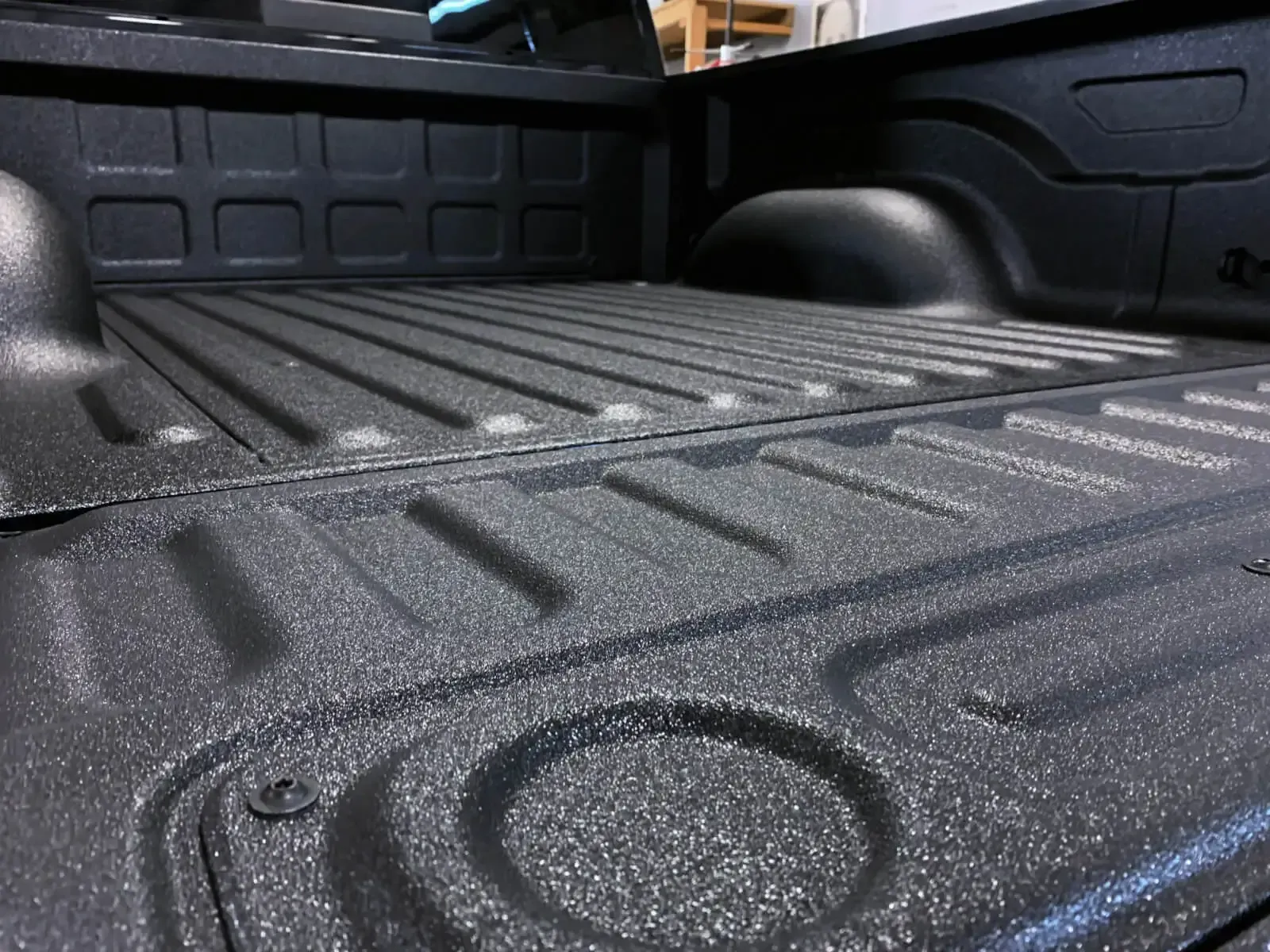
Spray-On Bed Liner
Truck beds deal with tools, lumber, equipment, cargo, water, and daily loading.
Z Tech is an authorized dealer for brands that include WeatherTech, Westin, REALTRUCK BAK, and Draw-Tite.
Truck Undercoating in Naperville FAQs
1. Is truck undercoating worth considering in Illinois?
It can make sense for trucks driven through Illinois winters because the underside is exposed to rock salt, salt brine, water, slush, gravel, and other road material. IDOT uses large amounts of salt each winter, so trucks driven year-round see repeated exposure.
2. What parts of a pickup truck can be undercoated?
Suitable areas may include sections of the frame, wheel wells, floor pans, inner fenders, and other exposed underbody surfaces. The exact treatment depends on the truck and product. Brake parts, exhaust components, drains, sensors, and certain moving parts should not simply be covered.
3. Can undercoating stop rust that is already on my truck?
Undercoating can help protect suitable metal, but it does not repair serious corrosion or replace damaged steel. Existing rust should be inspected first. Loose corrosion or structural damage may need attention before coating.
4. Is rubberized undercoating good for pickup trucks?
Rubberized undercoating can be suited to exposed areas that face road spray and abrasion. 3M makes rubberized coatings for trucks that are designed to resist chipping, weather exposure, rust, and abrasion. The surface still needs proper cleaning and preparation before application.
5. Should I undercoat a brand-new truck?
A newer truck can be a good candidate because treatment can begin before years of road salt exposure accumulate. Whether it makes sense depends on how long you plan to own the truck, how it is used, and where it is driven.
6. Do I still need to wash my truck after undercoating?
Yes. Salt can reach suspension parts, brakes, fasteners, shields, and other sections that are not coated. Regular winter washing can help remove salty residue from exposed areas.
7. Where can I get truck undercoating in Naperville?
Z Tech Window Tinting provides undercoating at 1572 W Ogden Ave, Naperville, IL 60540. Call (630) 355-9555 or visit our contact page to tell us about your pickup and schedule an appointment.
Protect Your Truck Before Another Illinois Winter
Truck undercoating in Naperville is about putting another barrier between vulnerable underbody surfaces and the winter conditions your pickup sees every year.
Illinois roads are treated with rock salt and liquid deicers. Your tires then throw salty water, slush, gravel, and grime underneath the truck.
Frames, wheel wells, floor pans, crossmembers, and other exposed areas can take that abuse season after season.
Undercoating can help protect suitable surfaces against moisture, road spray, abrasion, and corrosion. Rustproofing can address seams and enclosed areas that may need a different type of treatment.
The best time to think about underbody protection is before serious corrosion is visible.
Z Tech Window Tinting has served drivers throughout Chicago’s west suburbs since 1975 and provides undercoating and rustproofing at our Naperville, IL and Countryside, IL locations.
Call our Naperville shop at (630) 355-9555 or visit our contact page to schedule your truck undercoating appointment.
Sources
Illinois Department of Transportation: Winter Weather Operations Publisher: Illinois Department of Transportation Publication Date: FY2026 information current through April 2026
Illinois Department of Transportation: Winter Road Conditions and Road Salting 101 Publisher: Illinois Department of Transportation Publication Date: Current webpage
3M Professional Grade Rubberized Undercoating 03584 Publisher: 3M Publication Date: Current product information
Dynatron Dyna-Pro Paintable Rubberized Undercoating 544 Publisher: 3M Publication Date: Current product information
3M Collision Repair Corrosion Protection Resources and SOPs Publisher: 3M Publication Date: Current technical guidance
ready to get started?
Contact Us For Quotes And Scheduling
Contact us Naperville, IL and Countryside, IL to get a clear plan for your vehicle. Tell us what you drive and what you want to accomplish, and we will match services to your goals. You can ask about window tint, paint protection film, ceramic coating, vinyl wrap, detailing, electronics, or accessories. We set expectations for timing, drop off, and aftercare so your day runs smoothly. Estimates are straightforward and organized by service so you can compare choices. When you prefer to move fast, we can start your booking right away.