Window Tinting in Woodridge & Darien, IL: Heat Rejection Options
Google Reviews
What our Customers say
Heading 1
Heading 2
Heading 3
Heading 4
Heading 5
Heading 6
Lorem ipsum dolor sit amet, consectetur adipiscing elit, sed do eiusmod tempor incididunt ut labore et dolore magna aliqua. Ut enim ad minim veniam, quis nostrud exercitation ullamco laboris nisi ut aliquip ex ea commodo consequat. Duis aute irure dolor in reprehenderit in voluptate velit esse cillum dolore eu fugiat nulla pariatur.
Window tinting in Woodridge, IL and Darien, IL can help drivers reduce solar heat coming through vehicle glass while also cutting glare, filtering UV rays, and changing the appearance of their windows. The trick is choosing film based on heat performance instead of assuming the darkest tint automatically keeps the cabin coolest.
That distinction matters during an Illinois summer.
A vehicle parked outside can absorb solar energy through the windshield, side windows, and rear glass. Once you start driving, air conditioning has to work against the heat already inside the cabin plus the solar energy continuing to pass through the glass.
Z Tech Window Tinting installs 3M automotive window film for drivers throughout Woodridge, IL, Darien, IL, Naperville, IL, Countryside, IL, and nearby Chicago suburbs. We are a 3M certified dealer and 3M vendor with several film families available for different levels of heat rejection, shade, privacy, and appearance.
If heat reduction is near the top of your list, here is how the main film choices compare.
Drivers often begin researching window tinting in Woodridge, IL and Darien, IL because the cabin feels hot after sitting outside.
Window film cannot stop a closed vehicle from heating up in direct sunlight.
It can reduce part of the solar energy entering through treated glass.
That can matter when sunlight is hitting:
Your arms
Your face
Front seats
Rear seats
Dashboard
Door panels
It can also matter when you spend a lot of time driving during afternoon sun.
Someone commuting between Woodridge, IL, Darien, IL, Naperville, IL, Downers Grove, IL, or other western suburbs may spend plenty of time with direct sunlight hitting one side of the vehicle.
Window Tinting In Woodridge &Amp; Darien, Il: Heat Rejection Options Naperville, Il & Countryside, Il | Jclojvqjksh8D9Jp936Ww 5C9Fi73U
Heat-focused film can reduce that solar load before it reaches the cabin.
This is one of the biggest misconceptions about automotive window tint.
A darker film does not automatically reject more heat than a lighter film.
Darkness is mainly described through visible light transmission, or VLT.
Heat performance uses other measurements.
A film can look relatively light while still rejecting a large amount of infrared energy.
That is why drivers considering window tinting in Woodridge, IL and Darien, IL should compare film specifications instead of choosing by appearance alone.
Think of it this way:
A dark film may be excellent for privacy and glare reduction.
A lighter premium film may provide stronger heat rejection while keeping the glass closer to its original appearance.
Both can make sense.
They simply serve different goals.
What TSER Means
TSER stands for Total Solar Energy Rejection.
3M defines TSER as the percentage of total solar energy rejected by filmed glass.
A higher TSER means less solar energy is transmitted through the treated glass under the stated test conditions.
TSER is useful because sunlight is made up of more than visible light.
When heat reduction is your main concern, TSER gives you a broader performance number than VLT alone.
3M currently lists:
Ceramic IR at up to 66% TSER
Crystalline at up to 64% TSER
Color Stable at up to 64% TSER
The exact result depends on the film grade, glass, and test conditions.
Do not compare only the maximum figure.
A specific shade within the product family may have a different rating.
What Infrared Rejection Means
Infrared energy is closely associated with the heat you feel coming through automotive glass.
3M publishes infrared measurements for several film families.
Its current automotive window-film information lists:
Ceramic IR at up to 95% infrared rejection
Crystalline at up to 99% infrared rejection
3M also publishes a measurement called IRER, or Infrared Energy Rejection.
IRER covers a wider infrared range and accounts for energy that can be absorbed and reradiated.
That means two percentages on film brochures may not measure the exact same thing.
When comparing films, check whether the numbers represent:
IRR
IRER
TSER
VLT
A good installer can walk through those numbers rather than treating every heat percentage as interchangeable.
3M Ceramic IR
3M Ceramic IR is one of the strongest choices for drivers focused on heat rejection.
It uses nano-ceramic technology and does not rely on metal.
3M currently lists the Ceramic IR Series at up to:
66% total solar energy rejection
95% infrared rejection
99.9% UV rejection
Ceramic IR is available in several shade levels.
That gives drivers a way to balance heat rejection with privacy and appearance.
Why Ceramic IR Works Well for Illinois Driving
Ceramic IR may suit you if you:
Park outdoors during the day
Commute during afternoon sun
Want strong heat rejection
Prefer a metal-free film
Want several shade choices
Use GPS and connected electronics
3M states that Ceramic IR’s non-metalized construction will not interfere with GPS, satellite radio, mobile devices, or 5G.
For many drivers considering window tinting in Woodridge, IL and Darien, IL, Ceramic IR is a strong place to start when summer comfort matters more than choosing the darkest glass.
3M Crystalline
3M Crystalline is another heat-focused option.
Instead of ceramic construction, Crystalline uses a proprietary multilayer optical film.
3M says the film combines more than 200 layers in material thinner than a Post-it Note.
Current 3M information lists Crystalline at up to:
64% total solar energy rejection
99% infrared rejection
99.9% UV rejection
It is also non-metalized.
Crystalline Can Stay Relatively Light
One of Crystalline’s main traits is its ability to provide strong solar performance without requiring a heavily darkened window.
This may appeal to drivers who want:
High heat rejection
A lighter appearance
Good outward visibility
Metal-free construction
UV filtering
Reduced glare
If you regularly drive after dark, a lighter film may also be easier for you to live with than a deeply tinted window.
That makes Crystalline worth comparing with Ceramic IR in person.
Ceramic IR vs Crystalline
Both are strong heat-control films, but they use different technology.
Feature
3M Ceramic IR
3M Crystalline
Construction
Nano-ceramic
Multilayer optical film
Maximum TSER
Up to 66%
Up to 64%
Maximum Published IR Rejection
Up to 95%
Up to 99%
Metalized
No
No
UV Blocking
Up to 99.9%
Up to 99.9%
Shade Choices
Dark to light
Darker and lighter options
Strong Fit
Heat rejection with ceramic construction
High infrared rejection with lighter-looking options
Maximum specifications come from 3M and vary by film grade and testing conditions.
Do not treat the highest number in each column as the result from every shade.
Ask Z Tech to compare the actual film grades that work with your vehicle and preferred appearance.
3M Color Stable
Not everyone shopping for window tinting in Woodridge, IL and Darien, IL wants the highest heat-focused film.
Appearance may matter just as much.
3M Color Stable gives drivers a rich charcoal tint while still providing strong solar performance.
Current Color Stable film uses ceramic nanoparticles with patented dye technology.
3M currently lists:
Up to 64% total solar energy rejection
Up to 99.9% UV blocking
Non-metalized construction
The film also comes in several VLT choices.
Why Choose Color Stable?
Color Stable may be a good match when you want:
Charcoal appearance
Added privacy
Glare reduction
Heat rejection
UV filtering
Non-metalized construction
It also gives vehicles the darker tint appearance many owners associate with aftermarket window film.
3M backs professionally installed Color Stable film with a limited lifetime warranty, subject to its current warranty terms.
3M FX-HP
3M FX-HP uses a hybrid of dyed and metalized film technology.
It provides another route to heat and UV rejection with a charcoal appearance.
Because it contains metalized film, FX-HP differs from Ceramic IR, Crystalline, and Color Stable.
It can appeal to drivers looking for:
Darker styling
Solar control
UV rejection
Glare reduction
Charcoal appearance
If keeping the film metal-free matters to you, Ceramic IR, Crystalline, and Color Stable are the better products to compare.
Comparing Heat Rejection Options
Here is a simple way to narrow your choices.
Choose Ceramic IR When
You want strong infrared heat rejection and prefer ceramic technology.
Choose Crystalline When
You want very high infrared rejection and are interested in maintaining a lighter-looking window.
Choose Color Stable When
You want heat control along with a deep charcoal appearance and added privacy.
Consider FX-HP When
You want a hybrid film with traditional charcoal styling and heat rejection.
The real question is what matters most every day.
Heat?
Privacy?
Appearance?
Nighttime visibility?
Your answer can point you toward the film family that fits your vehicle.
Does Dark Tint Keep a Car Cooler?
Not automatically.
A dark film can cut a large amount of visible light and glare.
That does not guarantee that it rejects more total solar or infrared energy than a lighter ceramic or multilayer optical film.
This difference becomes clear when you compare published specifications.
3M specifically states that Crystalline can reject more heat than many darker films without changing the vehicle’s appearance as much.
That makes film construction just as important as shade.
Choosing Film for a Daily Commuter
If you use your vehicle every day, think about more than the hottest afternoon.
Consider your full driving schedule.
You may drive:
Before sunrise
During afternoon sun
Through rain
Into parking garages
After sunset
A very dark film can provide privacy and glare reduction during daylight but may feel darker at night.
Lighter Ceramic IR and Crystalline grades can provide another option.
You can retain more visible light while still getting heat-rejection benefits.
This can make sense for people commuting from Woodridge, IL or Darien, IL to Naperville, IL, Downers Grove, IL, Oak Brook, IL, or other nearby communities.
Window Tint for SUVs and Trucks
SUVs and trucks often come with darker factory privacy glass behind the driver.
That darker appearance does not necessarily mean those windows have a heat-focused aftermarket film.
Factory privacy glass gets much of its appearance from the glass itself.
Adding compatible window film can provide additional solar properties while maintaining or changing the appearance.
The front side windows can also be tinted to create a more consistent look, subject to Illinois legal limits.
Ask Z Tech to evaluate the existing glass before selecting film.
Tinting Factory Privacy Glass
Factory privacy glass causes a lot of confusion because it already looks dark.
If heat rejection is your concern, ask what the glass itself is doing rather than judging by color alone.
A darker-looking rear window can still benefit from a heat-rejecting film applied over the inside surface when compatible.
This may appeal to:
SUV owners
Pickup owners
Minivan owners
Crossover owners
The final VLT will depend on both the existing glass and the new film.
That also matters when considering Illinois rules.
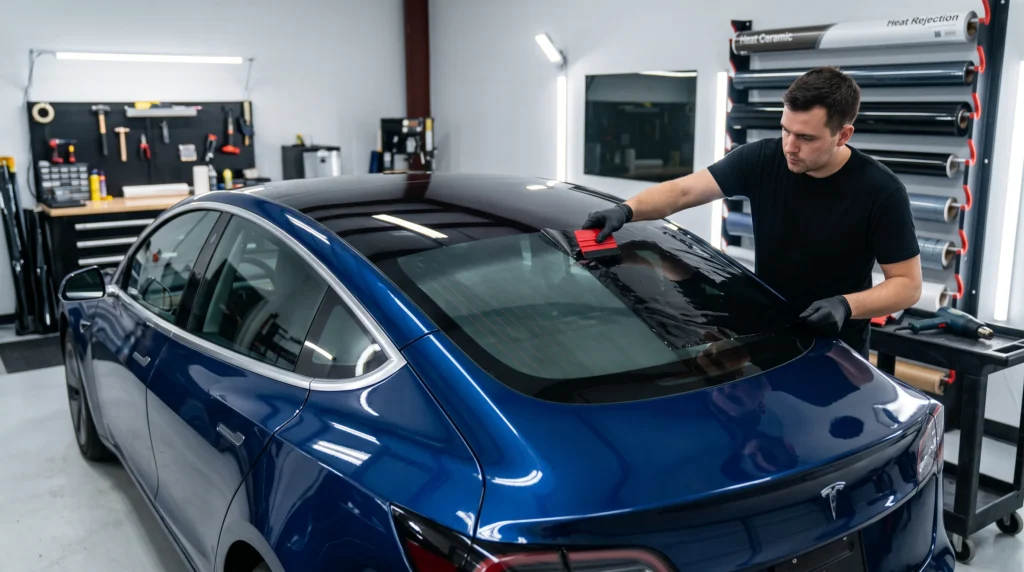
Window Tint for Tesla Vehicles
Tesla owners often pay close attention to heat because Model 3 and Model Y vehicles use large areas of glass.
Metal-free film can also make sense in a vehicle that relies heavily on connected electronics.
3M Ceramic IR and Crystalline are both non-metalized.
Z Tech has a dedicated Tesla window tint service for Tesla owners interested in heat rejection, UV filtering, privacy, and appearance.
Illinois generally prohibits tint across the main viewing area of the windshield.
The statute allows nonreflective tinted film along the uppermost portion of the windshield as long as the film does not extend more than six inches down from the top.
50% Front Side Window Configuration
When none of the windows behind the driver’s seat are treated below 30% light transmission, the statute allows nonreflective tint on the windows beside the driver that permits at least 50% light transmission.
Illinois provides a 5% variance when law enforcement meters the glass.
35% Front Side Window Configuration
When none of the windows behind the driver’s seat are treated below 35% light transmission, the law permits nonreflective tint beside the driver that allows at least 35% light transmission.
A 5% meter variance also applies under the statute.
Factory Privacy Glass
Illinois has another provision covering certain vehicles with nonreflective smoked or tinted glass installed by the manufacturer behind the driver.
That can affect the front side-window configuration.
Your existing vehicle glass should be considered before film is installed.
Film VLT and Finished VLT Are Not Always the Same
This matters when choosing a legal setup.
A film marketed at a certain VLT does not necessarily make the completed window meter at exactly that percentage.
The factory glass already blocks part of the visible light.
When film is added, both layers affect the finished transmission.
A shop should consider:
Existing glass
Selected film
Window position
Illinois law
Your preferred appearance
That is more useful than simply asking for “35% film” without looking at the complete glass system.
Window Tinting Near Woodridge & Darien
Drivers looking for window tinting in Woodridge, IL and Darien, IL can visit Z Tech’s nearby Naperville location:
Z Tech Window Tinting 1572 W Ogden Ave Naperville, IL 60540 Phone: (630) 355-9555 Hours: Monday through Saturday, 8:30 AM to 5:00 PM
Z Tech is family-owned and has served Chicago’s west suburbs since 1975.
Our Naperville location has more than 375 five-star reviews.
It depends on the measurement being compared. 3M currently lists Ceramic IR at up to 66% total solar energy rejection and up to 95% infrared rejection. Crystalline reaches up to 64% total solar energy rejection and up to 99% infrared rejection under 3M’s stated measurements.
2. Is ceramic tint good for Illinois summers?
Yes. Heat-focused ceramic film can make sense for Illinois drivers who regularly park outside or spend long periods driving in direct sunlight. 3M Ceramic IR uses nano-ceramic technology and comes in several shade levels.
3. Does darker window tint reject more heat?
Not necessarily. VLT measures visible light, while heat performance is described through measurements such as TSER and infrared rejection. A lighter premium film can reject more heat than some darker films.
4. What is the difference between Ceramic IR and Crystalline?
Ceramic IR uses nano-ceramic technology. Crystalline uses a proprietary multilayer optical film with more than 200 layers. Both are non-metalized and built for high heat rejection, but their film construction, appearance, VLT choices, and performance figures differ.
5. Can I tint factory privacy glass?
Aftermarket film can be installed over compatible factory privacy glass to add solar performance or change the finished appearance. The existing glass affects the final VLT, so it should be considered before selecting a film.
6. Will ceramic tint interfere with my GPS or phone?
3M says Ceramic IR is non-metalized and will not interfere with electronics, satellite radio, GPS, mobile devices, or 5G. Crystalline and current Color Stable products are also non-metalized.
7. Where can I get window tinting near Woodridge, IL and Darien, IL?
Z Tech Window Tinting serves Woodridge, IL and Darien, IL from our Naperville shop at 1572 W Ogden Ave, Naperville, IL 60540. Call (630) 355-9555 or visit our contact page to discuss your vehicle and current 3M film choices.
Choose Window Tint Based on Heat Performance
Window tinting in Woodridge, IL and Darien, IL does not have to mean choosing the darkest glass available.
Start with what you want the film to do.
If heat rejection comes first, compare Ceramic IR and Crystalline.
If you want a darker charcoal appearance along with strong solar control, look at Color Stable.
If you prefer a hybrid film, ask about FX-HP.
Then compare the actual shade, TSER, infrared performance, UV rejection, existing vehicle glass, and Illinois tint rules.
Z Tech Window Tinting has served Chicago’s west suburbs since 1975 and installs professional 3M automotive window films from our Naperville, IL and Countryside, IL locations.
Call our Naperville shop at (630) 355-9555, call our Countryside shop at (708) 354-9555, or visit our contact page to compare film choices and schedule your window tint appointment.
Sources
3M Automotive Window Films Publisher: 3M Publication Date: Current product information, accessed September 2026 URL: https://www.3m.com/3M/en_US/p/c/films-sheeting/window/light-control/i/automotive/post-factory-installations/
3M Automotive Window Film Crystalline Series Publisher: 3M Publication Date: Current product information, accessed September 2026 URL: https://www.3m.com/3M/en_US/p/d/b00016683/
625 ILCS 5/12-503 Publisher: Illinois General Assembly Publication Date: Current Illinois Compiled Statutes URL: https://www.ilga.gov/Legislation/ILCS/Fulltext?DocName=062500050K12-503
ready to get started?
Contact Us For Quotes And Scheduling
Contact us Naperville, IL and Countryside, IL to get a clear plan for your vehicle. Tell us what you drive and what you want to accomplish, and we will match services to your goals. You can ask about window tint, paint protection film, ceramic coating, vinyl wrap, detailing, electronics, or accessories. We set expectations for timing, drop off, and aftercare so your day runs smoothly. Estimates are straightforward and organized by service so you can compare choices. When you prefer to move fast, we can start your booking right away.